When the Leader Is Human
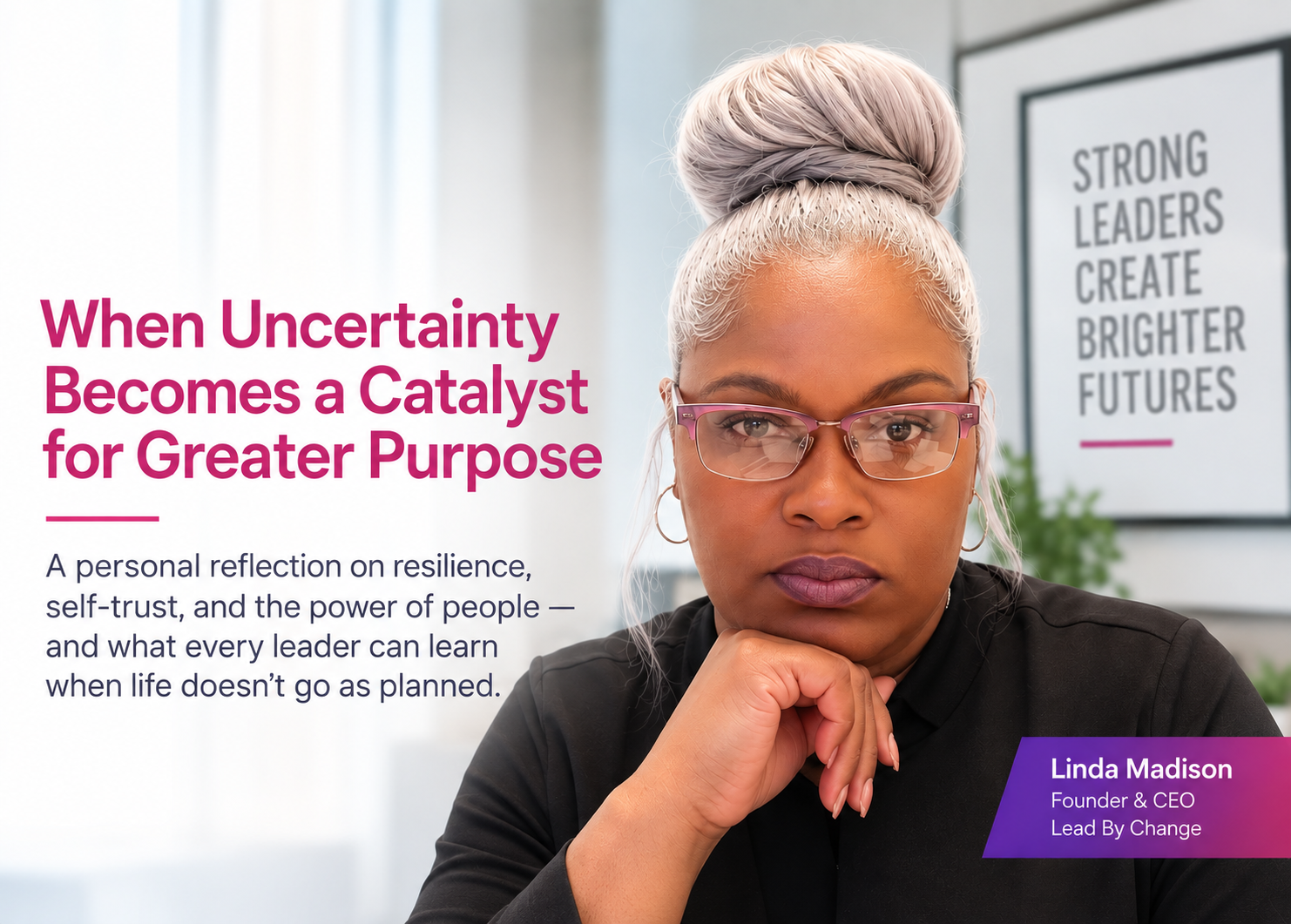
Three Years Later… | Leadership Series · Part II
When the Leader Is Human
Leading Through Personal Adversity Without Losing Purpose
“Adversity did not take away my ability to lead. It reminded me that leadership was never about appearing invincible—it was about trusting myself, trusting the people around me, and continuing forward when the path was no longer predictable.”— Linda Madison, Founder & CEO, Lead By Change
I have spent much of my career helping leaders navigate uncertainty inside organizations.
But leadership feels different when the uncertainty becomes personal.
There are moments when life interrupts the strategic plan. When the leader who normally carries answers is suddenly carrying questions. When strength must coexist with vulnerability, and faith must stretch beyond what the circumstances seem to support.
I have learned that these moments do not disqualify us from leadership.
Sometimes they teach us how to lead more honestly.
Personal adversity has a way of stripping leadership down to its foundation.
Titles matter less. Appearances matter less. The illusion of control begins to loosen.
What remains is trust: trust in your preparation, trust in your team, trust in your values, trust in your faith, and sometimes simply trust that the next step will reveal itself when you are ready to take it.
Leadership Truth
Strength is not pretending nothing hurts. Strength is deciding that what hurts will not determine how you lead.
When Life Interrupts Leadership
Nonprofit executives are accustomed to carrying complexity. Funding uncertainty. Staffing shortages. Board expectations. Community demands. Program outcomes.
But few leadership models prepare us for the moment when organizational pressure collides with personal adversity.
The instinct is often to compensate.
Work harder. Say less. Prove you are still capable. Protect everyone else from knowing how much you are carrying.
That instinct may keep things moving temporarily—but it can quietly undermine both the leader and the organization.
The Leadership Pivot
The goal is not to prove that adversity cannot affect you. The goal is to lead wisely while acknowledging that it has.
Shed the Superhuman Mask
Leadership culture often rewards the appearance of invulnerability.
We praise leaders who are always available, endlessly productive, calm under every circumstance, and somehow capable of absorbing unlimited responsibility.
But sustainable leadership does not require superhuman performance.
Physical or emotional vulnerability does not erase competence. Asking for support does not diminish authority. Adjusting capacity does not mean abandoning commitment.
Sometimes the most credible leadership statement you can make is:
Permission to Lead Differently
“I am still committed to the work. I simply cannot lead it in exactly the same way right now.”
Five Practices for Leading Through Personal Adversity
Remember the experience, judgment, and values that prepared you long before the crisis arrived.
Clearly define availability, recovery time, and what genuinely requires your attention.
Treat physical, mental, and emotional wellbeing as leadership infrastructure—not an optional benefit.
Give capable people real responsibility. Leadership is stronger when knowledge and authority are distributed.
Recovery is not lost productivity. It protects the capacity required for sustainable leadership.
Stop Over-Performing
One of adversity's most dangerous traps is the pressure to prove that nothing has changed.
Leaders may begin working twice as hard because they fear being perceived as less committed, less capable, or less reliable.
But over-performing is not resilience.
It is often fear disguised as productivity.
Sustainable leadership asks a different question:
Executive Reflection
What would leadership look like if I stopped trying to prove my strength and started protecting the strength I need for what comes next?
Trust the Team You Worked So Hard to Build
Personal adversity reveals something else:
Whether we have built teams—or dependency.
If the organization cannot function when the leader temporarily steps back, that is not evidence of indispensable leadership.
It is evidence of organizational risk.
Delegation during adversity should not begin as a crisis response. It should reflect a culture already grounded in shared knowledge, clear decision authority, cross-training, and succession readiness.
Sometimes trusting your team is not simply an operational decision. It is an act of leadership humility.
Organizational Lesson
Strong leaders do not make themselves indispensable. They build people and systems capable of carrying the mission forward.
Reframe Rest as Strategy
Leaders regularly schedule budgets, board meetings, performance reviews, strategic planning sessions, and fundraising deadlines.
Yet rest is often expected to occur only when everything else is finished.
Everything is rarely finished.
Rest must therefore become intentional.
When facing a personal or health challenge, recovery time is not a leadership failure. It can be an essential part of maintaining the judgment, emotional regulation, physical capacity, and perspective leadership requires.
Reactive Thinking
“I will rest when the work is done.”
“No one else can handle this.”
“If I slow down, everything will fall apart.”
Strategic Thinking
“Recovery protects my ability to lead.”
“Delegation develops other leaders.”
“A sustainable organization cannot depend on one person.”
A Leadership Check-In
Ask Yourself Honestly
- What am I carrying privately that is affecting how I lead publicly?
- Where am I over-performing instead of asking for support?
- Which responsibilities genuinely require me—and which can be delegated?
- Have I communicated clear boundaries to my team and board?
- Does my organization have enough leadership depth to operate without my constant presence?
- Am I treating recovery as preparation—or as something to feel guilty about?
- What is this season teaching me about the leader I want to become?
Vulnerability and Authority Can Coexist
Leaders sometimes fear that acknowledging difficulty will cause people to lose confidence.
But thoughtful vulnerability can create the opposite effect.
It reminds people that leadership is human.
Vulnerability does not require disclosing every private detail. It requires enough honesty to prevent silence from creating confusion.
You can be transparent without surrendering privacy.
You can be strong without pretending.
You can lead and still need care.
“You can lead with strength and still be human. Vulnerability does not diminish your leadership—it can deepen the trust that makes leadership possible.”— Linda Madison
What Adversity Can Give Back
None of us would choose every difficult season we experience.
But adversity can still leave something valuable behind.
Perspective.
Deeper empathy.
Clearer boundaries.
Greater trust in others.
A more honest relationship with our own limitations.
And sometimes, renewed conviction about why the work matters in the first place.
What I Know Now
Adversity may interrupt your rhythm. It does not have to interrupt your purpose.
Gratitude Matters in Difficult Seasons
To the people who have continued to support Lead By Change, thank you.
To our clients and partners who trust us with meaningful work, thank you.
To the colleagues, community members, friends, followers, and leaders who have offered encouragement, partnership, referrals, perspective, and grace—thank you.
Difficult seasons have a way of revealing not only what matters, but who matters.
I do not take that community for granted.
How Lead By Change Supports Leaders Through Change
Leadership challenges are rarely isolated.
A leadership transition can expose succession gaps. Executive fatigue can reveal workload and governance problems. Culture challenges can uncover unclear HR systems. Financial pressure can accelerate difficult workforce decisions.
Lead By Change brings leadership, people strategy, finance, organizational development, and facilitation together so leaders can address the whole organization—not simply the most visible symptom.
You Do Not Have to Lead Through It Alone
If you are navigating a leadership transition, personal adversity, organizational strain, culture challenge, workforce decision, or uncertain next chapter, begin with a conversation.
Lead By Change can help you step outside the immediate pressure, assess what the organization needs, strengthen the systems around you, and develop a path forward that protects both mission and people.
You do not need to arrive with all the answers.
Sometimes the first leadership decision is simply deciding not to carry everything alone.
A Final Word
You are allowed to be both a strong leader and a human being navigating something difficult. One does not cancel the other.
Leadership during adversity is not about controlling the outcome.
It is about staying connected to purpose while responding wisely to what the moment requires.
Dig deep.
Trust what you have built.
Trust the people you have developed.
Protect what restores you.
Release the need to prove you are invincible.
And when uncertainty asks whether you still believe things can work out—
remember how much work, faith, preparation, courage, and community brought you this far.
— Linda Madison
Founder & CEO, Lead By Change
From Insight to Sustained Leadership
A deeper guide for leaders ready to move beyond reaction and lead with clarity
Empowering Change Through Strategic Stillness was written for leaders navigating uncertainty while refusing to abandon vision.
It is not about slowing down. It is about leading with clarity, courage, and compassion—especially in environments where pressure is constant and decisions carry weight.
Inside, you will find practical tools to navigate complexity without losing alignment, manage change without burning out, and strengthen both personal resilience and organizational impact.